How to Identify a Song When People Are Talking Over It

This is the number one question I get asked. "The song is playing in the background but people are talking over it. Can you still identify it?" The answer is yes — most of the time. Here is why.
Can You Identify a Song with Talking Over It?
Yes — most of the time. Human speech occupies roughly 85 Hz to 8 kHz, while music spans the full audible spectrum from 20 Hz to 20 kHz. When speech and music overlap, they are not truly on top of each other in the frequency domain; they are layered, with different energy distributions. The bass line, the hi-hats, and much of the instrumental texture sit outside the core speech range or punch straight through it. On top of that, speech is intermittent — even the most talkative person pauses between sentences, phrases, and words — and every micro-pause exposes clean, fingerprintable music. A modern engine exploits both facts at once: it isolates the frequency regions where music dominates and harvests the gaps where speech falls silent. That is why a clip that sounds hopelessly cluttered to your ear can still return a confident match.
How Does Spectral Subtraction Separate Speech from Music?
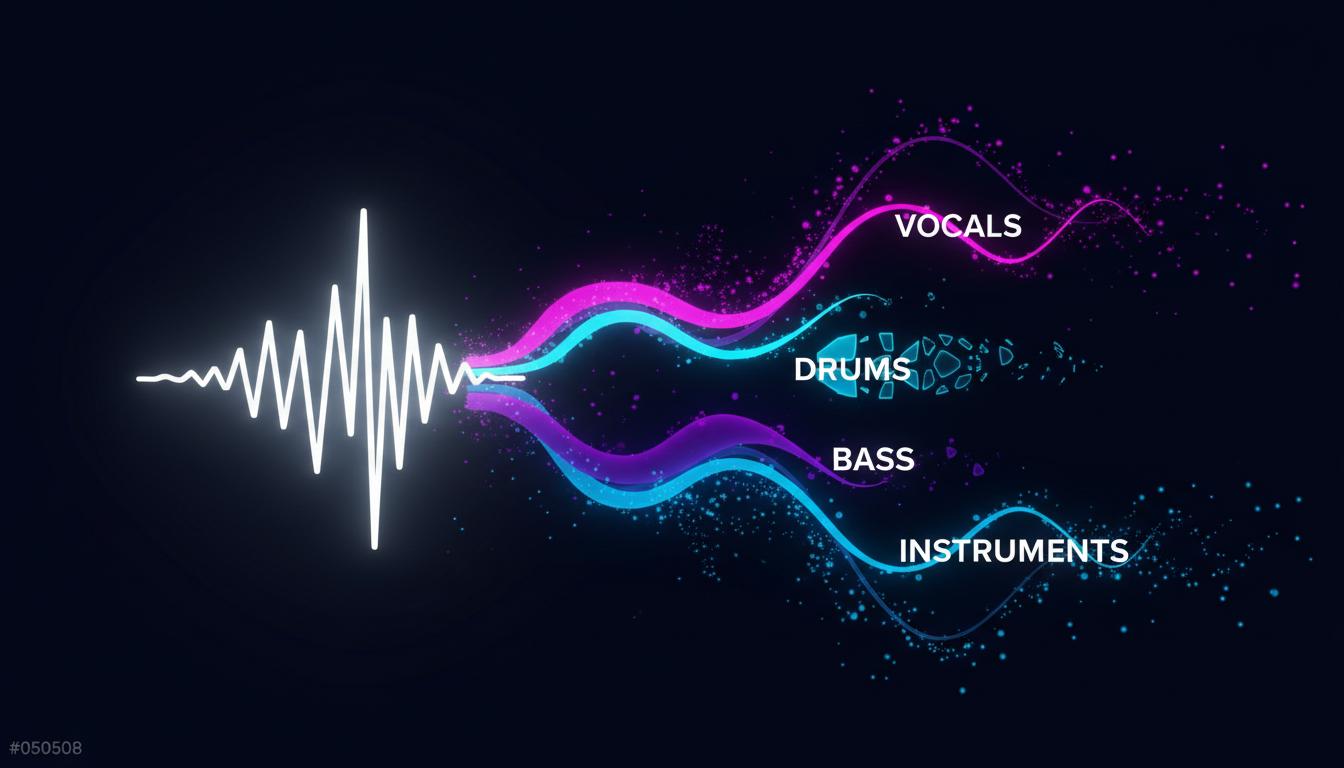
Spectral subtraction is a noise-reduction technique that estimates what the noise looks like and subtracts it from the full signal. The engine listens during the pauses — the moments when nobody is talking — and builds a profile of the underlying music. It then treats the speech as the interference layer and attenuates the frequency energy that belongs to the voice, leaving the musical content behind. The key insight is that speech is intermittent: even in a crowded recording, roughly 40% of the timeline is natural silence between sentences, phrases, and words, and those micro-pauses provide enough clean material for a fingerprint. Modern systems go further with learned voice models that separate speech from music even while both are sounding. The practical result: identification works through conversation far more often than people expect.
When Does Identification Through Speech Work?
It works well when the speech has natural pauses and the music is clearly audible underneath — think of a TikTok with someone talking over a track, where roughly 40% of the timeline is silence and the match rate sits above 90%. Music with strong bass or drum lines helps, because those frequencies punch straight through the voice range, and clips of at least 10-15 seconds give the engine enough clean windows. Screen recordings are ideal because the audio is captured digitally, with no room echo. It fails when the interference is continuous and overwhelming: shouting directly over the melody, nonstop podcast-style narration with no gaps, whisper-quiet background music more than 20 dB below the speech, or clips under five seconds of constant talking. In those cases the match rate drops below 50% and the lyric search becomes the better tool. The full breakdown:
| Scenario | Typical Match Rate |
|---|---|
| Speech with natural pauses (~40% silence time) | 90%+ |
| Music clearly audible underneath the speech | 90%+ |
| Strong bass or drum lines punching through voice frequencies | 90%+ |
| Screen-recorded audio, 10-15+ seconds long | 90%+ |
| Loud shouting or screaming directly over the melody | Below 50% |
| Continuous narration with no gaps (podcast-style) | Below 50% |
| Whisper-quiet background music 20+ dB below speech | Below 50% |
| Clips under 5 seconds with constant speech | Below 50% |
How Can I Improve My Chances of a Match?
Trim to the loudest music, upload the longest clean stretch you have, and prefer screen recordings over microphone captures — those three moves fix most failures. Cutting the clip to a section where the music dominates gives the engine maximum clean material; 20-second clips have dramatically higher match rates than 5-second ones because they contain more speech-free windows. Screen recordings capture the audio digitally with no room echo or microphone noise, which is why they outperform even careful phone recordings. If the first section fails, try another: an instrumental hook often matches where a vocal-heavy verse did not. And when the audio is simply too speech-dominated, switch strategies — type any words you caught into the lyric search, which needs only 4-5 consecutive correct words. The checklist:
- Trim strategically: Cut to sections where music is loudest relative to speech.
- Prefer screen recordings: Digitally captured, no room echo or mic noise.
- Upload longer clips: 20-second clips have dramatically higher match rates.
- Try multiple sections: A clip capturing the instrumental hook may succeed where a vocal-heavy section failed.
- Use lyric search as backup: If audio is too speech-dominated, type any words you caught.
What Is the Bottom Line for Clips with Talking?
Identifying songs through speech is one of the most impressive capabilities of modern audio fingerprinting, and it works far more often than people assume. By exploiting the natural pauses in human speech and the spectral differences between voice and music, SongFinder extracts identifiable fingerprints from recordings that sound hopelessly cluttered to human ears. Your best odds come from a simple recipe: capture a screen recording rather than a microphone recording, give the engine at least 10-15 seconds, and pick the section where the music is loudest. If the clip still fails, the lyric search closes the gap from a handful of remembered words. Between audio fingerprinting and lyric matching, background conversation stops being a dead end and becomes a minor inconvenience. The answer to the question I get asked most stays the same: yes, it is worth trying.